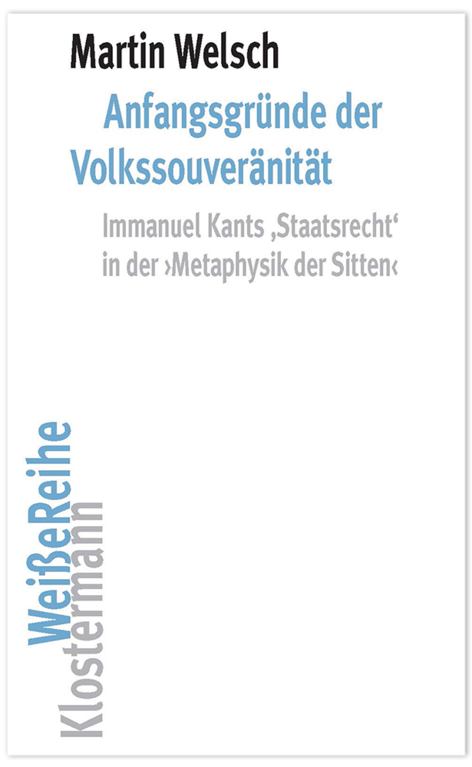
Immanuel Kants 'Staatsrecht' in der "Metaphysik der Sitten"
2021. 476 Seiten. Kt 32,00 €
ISBN 978-3-465-04575-5
Klostermann Weiße Reihe 5
Auch als  erhältlich
Kants 'Staatsrecht' in der "Metaphysik der Sitten" stellt wohl die schärfste Analyse und Kritik der demokratischen Moderne nach 1789 dar. Das musste unerkannt bleiben, solange die immer wieder beklagte Problemverfassung der Spätschrift auf die angebliche Senilität des Autors zurückgeführt wurde oder man chaotische Vorgänge bei der Drucklegung für die Textverfassung verantwortlich machte. Tatsächlich aber ist sie Ausdruck der Brillanz einer bis heute unerforschten philosophischen Rhetorik, die als Höhepunkt und Glanzstück des Kantischen Schaffens angesehen werden muss. Indem Martin Welsch ihr erstmals in der Geschichte der Kant-Literatur Achtung schenkt, deckt er zugleich eine bislang unbeachtete Spielart radikaler Volkssouveränität auf, die unsere politische Gegenwart in ein neues Licht stellt.
Die Arbeit wurde im Rahmen des Johannes Zilkens-Promotionspreises der Studienstiftung des deutschen Volkes ausgezeichnet (besondere Anerkennung der Jury). Unter diesem Link finden Sie Näheres dazu, u.a. auch ein Porträt des Autors.
"Unprecedented and pathbreaking interpretation." Kantian Review
"Welschs Methode, einen ideengeschichtlichen Klassiker gründlich gegen den Strich zu bürsten und bislang unerforschte, radikale Elemente seines Denkens zu erschließen, ist inspirierend."
Zeitschrift für politische Theorie
"Wer meint, die gegenwärtige akademische Philosophie würde sich mit weltfremden, praktisch und politisch bedeutungslosen abstrakten Problemen befassen, der sollte einen Blick in die Dissertation von Martin Welsch werfen."
DIE WELT
"Welschs Interpretation [dürfte] einen Paradigmenwechsel in der Sicht auf das Staatsrecht einleiten."
AmosInternational
"Dem Verfasser gelingt die Verwirklichung von dem, was Denkern von Bacon und Vico bis Benjamin und Auerbach als das Ideal einer Vermählung von Philologie und Philosophie vor Augen stand."
Peter König
"Eine meisterhafte Leistung."
Hans Friedrich Fulda
Kant's 'Staatsrecht' in the "Metaphysik der Sitten" very likely represents the sharpest analysis and critique of democratic modernity after 1789. This, however, had to remain unrecognized as long as the repeatedly lamented problematic nature of this late text was attributed either to the alleged senility of the author, or else confusion created in the course of the printing process was blamed for its inscrutable composition. In fact, however, it is an expression of the brilliance of a philosophical rhetoric that has remained unexplored to this day and must be regarded as the culmination and pièce de résistance of Kant's oeuvre. By focussing the attention to this piece of writing for the first time in the history of Kant scholarship, Martin Welsch uncovers a hitherto unnoticed variant of the notion of radical popular sovereignty that sheds new light on our political present.